
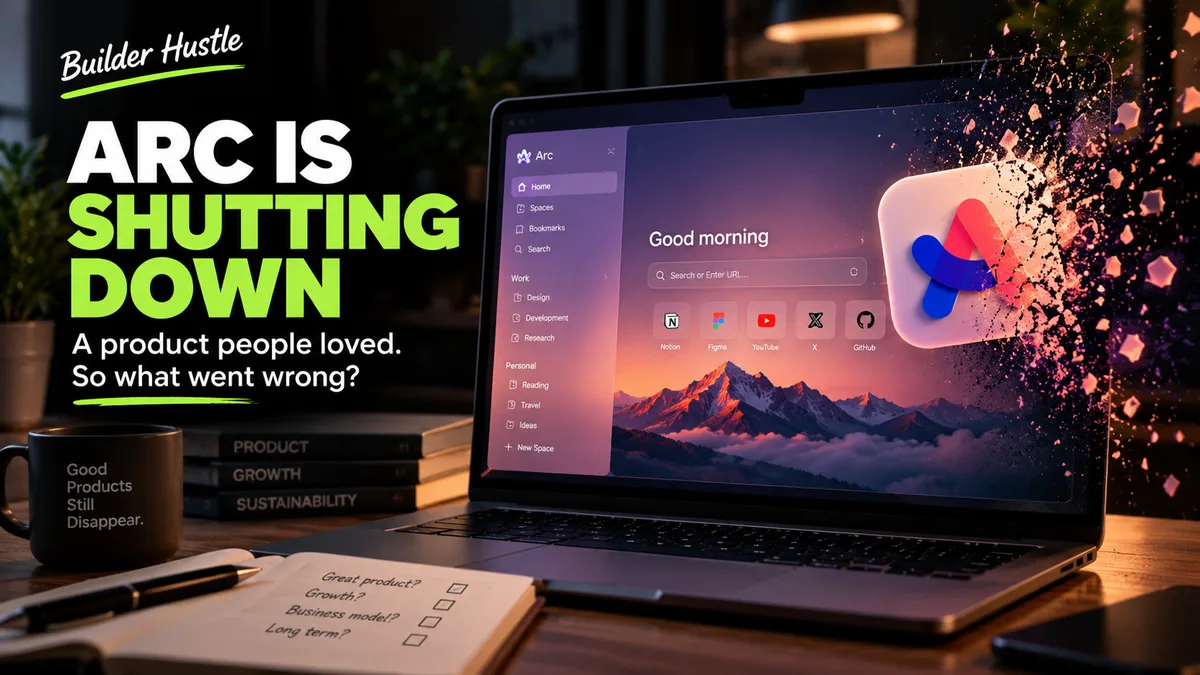
People loved the browser, but that wasn’t enough. Arc is shutting down in December, and there’s a lesson here for anyone building a product.
I’ve seen plenty of apps disappear over the years, but Arc is an interesting one. It wasn’t some random app nobody had heard of. People genuinely liked using it, and for a while, it felt like one of the few browsers trying to do something different.
Now, that’s coming to an end.
The Browser Company announced on October 22 that Arc will stop working on Mac and Windows on December 22, 2026. The team is moving its focus to Dia, its newer browser. Existing users can continue using Arc until the shutdown, but new accounts can no longer be created.
Here’s the official announcement.
So, what happened?
Arc wasn’t trying to be another Chrome. It had vertical tabs, workspaces called Spaces, and a different way to organize your browsing. If you spend most of your day jumping between websites, documents and projects, those little details could make a real difference.
The problem was that Arc never became a browser for everyone.
Its design appealed to a loyal group of users, but it also came with a learning curve. The team had already stopped developing new Arc features last year to focus on Dia, and now it has decided to retire Arc completely.
According to TechCrunch’s report, the company says keeping a browser secure requires constant work, and it wants its engineering and security teams focused on Dia instead.
I can understand the reasoning. Maintaining a browser is a serious job, especially when it comes to security. Supporting two separate products takes time and money, and the company has decided where it wants to invest those resources.
Still, it’s a shame to see a product with such a devoted community go away.
Stop Being the Human Glue: Build a Company OS in Notion
In the beginning, the founder often is the system. They answer every question, approve every decision, remember every customer detail, and connect every moving part. That level of involvement may feel necessary early on, but over time it turns the founder into the company’s biggest bottleneck. A lightweight company operating system helps replace constant interruptions with shared context. Instead of asking where the latest deck lives, what was decided in last week’s meeting, or who owns a launch, the team can self-serve from one central workspace. Weekly priorities, project owners, meeting notes, onboarding resources, customer context, and key decisions all have a clear home. The result is not just better organization. It is more autonomy. When the team knows where to find information and how work moves forward, founders spend less time repeating themselves and more time making high-leverage decisions. A clear operating system gives early-stage companies the structure they need without slowing them down. Spend less time answering repeat questions and more time building.
Try Notion today and get up to 3 months free of Notion Business with Notion AI.
Making a good product isn’t the whole job
This is the part I find interesting as someone who builds things on the internet.
You can make a product people enjoy using and still struggle to turn it into something that lasts. Getting people excited about a launch is one thing. Giving them a reason to keep using your product, reaching new users and paying for the work needed to maintain it are different challenges.
Arc had a clear identity. It looked different, worked differently and gave people a reason to try something other than Chrome. But being different can also make a product harder to understand. Sometimes the things your biggest fans love about your product are the same things that make it harder to reach a wider audience.
That doesn’t mean you should make everything simple just to attract more users. It means you need to understand who you’re building for and how much of the market you can realistically reach.
There’s also a practical lesson here: every product comes with ongoing responsibilities. You can’t just build something, launch it, and move on to the next idea without thinking about what happens afterward.
I’ve been thinking about this with my own projects
I just shipped another product myself: VRHow, a website that helps people explore VR headsets, find games and check whether their PC can handle virtual reality. We’ve also launched on Product Hunt.
Right now, the exciting part is getting the product out there and seeing what people think. But that’s only the beginning. I’ll need to keep the information updated, fix things that don’t work as expected, and figure out which features people actually find useful.
Arc is operating on a completely different scale, of course. But the basic challenge is familiar: launching a product is one milestone, not the finish line.
What I’d take away from Arc
I don’t think Arc shutting down means it was a bad product. Sometimes a team learns that its original idea isn’t the business it wants to build long-term, and it has to make a difficult choice.
But it does remind us that a product needs more than a clever idea and a loyal early audience. It needs a clear reason for people to use it, a way to keep growing, and a plan for supporting it over time.
If you’re building something right now, don’t only think about how you’ll launch it. Think about what you’ll do when the first wave of attention passes. What will bring people back? What will make them recommend it? And what will make the work worth continuing?
Those questions aren’t as exciting as shipping a new feature, but they’re just as important.
Arc had its moment, and plenty of people will miss it. Now the team is betting on Dia instead. It’ll be interesting to see whether that decision pays off.
Stay sharp,