
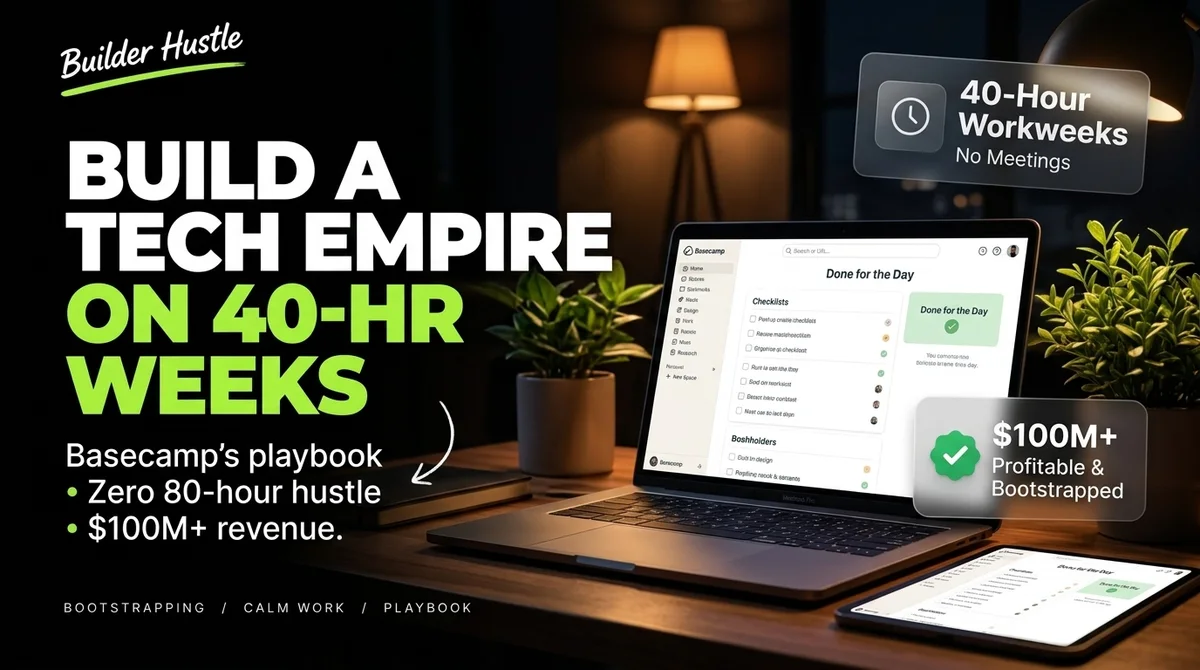
The company that got more done by working less
In 2020, while most of the tech industry was bragging about 80-hour weeks and “extreme ownership,” a small software company called Basecamp published something unusual. A book called It Doesn’t Have to Be Crazy at Work. Their argument was simple and, at the time, almost heretical: most companies aren’t busy because the work demands it. They’re busy because busyness has become a costume people wear to look committed.
Basecamp ran a 32-hour work week for most of the summer, every summer, for years. Shorter days. Fewer meetings. No expectation of being online at night. And they didn’t just survive it. They shipped products, grew revenue, and kept a team that stuck around for a decade in an industry where two years counts as loyalty.

They weren’t the only ones to figure this out. A few years later, the fintech company Ramp took a different but related approach. Instead of shortening hours, they attacked meetings directly. Internally, they built a culture where meetings needed a written agenda to exist at all, and if a decision could be made async in a doc or a Slack thread, it had to be. One of their operating principles, reported widely in profiles of the company, was blunt: if you can avoid a meeting, avoid it. Ramp became one of the fastest-growing fintech companies in the US while running leaner on process than most competitors ten times their size.
What both companies actually did differently
Strip away the branding and the founder quotes, and both companies were running the same three moves.
1. They protected blocks of uninterrupted time as a company policy, not a personal favor.
At Basecamp, this meant no scheduled meetings during certain windows, company-wide. Not “try to avoid meetings if you can.” An actual rule. Individual willpower is unreliable. A structural rule isn’t.
2. They batched communication instead of letting it interrupt work in real time.
Ramp’s async-first approach meant most questions got answered within a defined window, not the instant they were asked. This sounds small. In practice, it’s the difference between a team that responds to every ping and a team that actually finishes things.
3. They treated rest and boundaries as part of the system, not an exception to it.
Basecamp’s summer hours weren’t a perk handed out when things were slow. They were scheduled the same way a product launch gets scheduled. The company built its roadmap around the assumption that people would have less working time in the summer, not around the hope that everyone would just push through.
The framework behind it: Protect, Batch, Release
Pull these patterns apart and you get a structure any team or solo builder can copy, regardless of company size.
Protect a fixed block of deep work time, and make it a rule rather than a suggestion. If it’s optional, it gets sacrificed the first time something urgent comes up.
Batch reactive work. Messages, emails, and requests get answered in defined windows instead of constantly, so focus time stays actually focused.
Release the assumption that more hours equal more output. Both companies above did less total work-time and shipped more, because the hours they kept were higher quality.
Why this matters more for small teams and solo builders
It’s tempting to write this off as something only a funded company with HR policies can pull off. It’s actually the opposite. A solo builder or a five-person team has less slack to absorb wasted hours, which means the cost of an interrupted, unfocused day is higher, not lower. If a 300-person company can protect a block of deep work company-wide, a two-person team can absolutely protect two hours on a calendar.
One thing to try this week
Pick one recurring meeting or interruption that eats into your best working hours. Move it, batch it, or kill it entirely for one week. Don’t ask permission if you don’t have to. Just run the experiment and see what changes.
From the community
“We killed our daily standup and replaced it with an async doc. Nobody missed it. We got two extra hours back across the team, every single day.”
Before you go
If this issue was useful, forward it to one builder who needs to read it. That’s the whole growth strategy around here, and it works because of you.
See you soon.
- Builder Hustle