
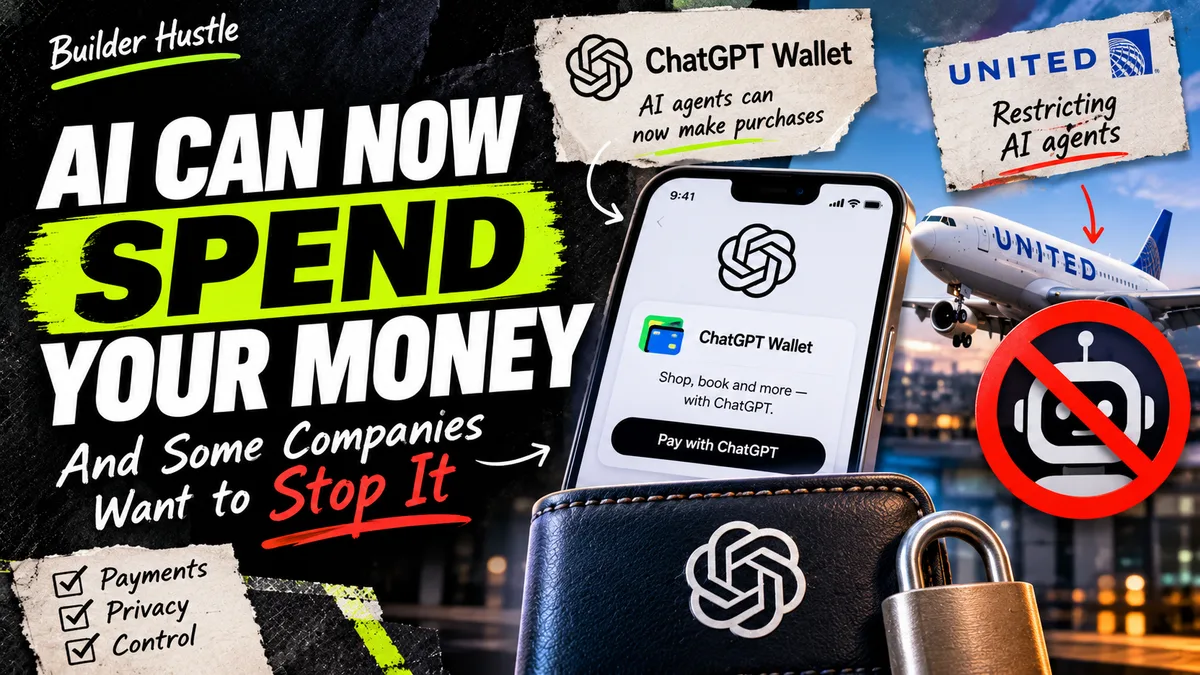
AI assistants are moving beyond recommendations. They’re getting closer to making purchases on our behalf.
OpenAI is introducing a wallet for AI-powered purchases, while United Airlines is restricting unauthorized AI agents from accessing its platforms.
Two very different approaches, and one important question: how much should we trust AI with our money and personal accounts?
Here’s what happened and why it matters…
Imagine asking an AI assistant to plan a weekend trip.
It finds a hotel, compares flight prices, checks the cancellation policies and narrows everything down to an option that fits your budget. Then, instead of sending you a collection of links, it offers to complete the purchase.
You approve. The booking is made.
That experience is getting closer. But not everyone is comfortable with it.
On November 13, OpenAI introduced ChatGPT Wallet, a way for its AI agents to make purchases on behalf of users. Just two days earlier, United Airlines announced that it was restricting unauthorized third-party AI agents from accessing its digital platforms.
These announcements tell two very different stories about where AI is going.
One is about removing friction from everyday transactions. The other is about protecting accounts, money and customer control.
And both are going to matter as AI assistants become more capable.
ChatGPT is moving beyond helping you shop
Until now, much of the AI shopping experience has been about research.
You ask for recommendations, compare products, explore alternatives and perhaps get a link to a store. The actual purchase is still your responsibility.
ChatGPT Wallet moves that process one step further.
Users can add an eligible payment card to the wallet. When an AI agent is ready to make a purchase, the user reviews the merchant, items, total and selected card. They then authorize the transaction using a security check such as Face ID or a fingerprint scan.
There is an important detail here: the agent does not receive the user’s actual card details.
After approval, the payment network provides a substitute payment credential for the transaction. The purchase is charged to the selected card without exposing the real card number to the agent or business.
OpenAI developed the wallet with American Express, Mastercard and Visa. Users also retain their card rewards and protections for eligible disputes.
That is a meaningful step because the AI is no longer simply recommending what to buy. It can now participate in completing the transaction.
However, this is not yet a global shopping feature. The initial rollout is through OpenAI’s dots product for ChatGPT Pro subscribers aged 18 or older in the United States, with eligible US-issued cards.
OpenAI also describes a future in which users could authorize purchases under predefined conditions, such as spending limits, product categories or time periods.
That more autonomous experience is a future direction, not what the initial rollout currently provides.
In Partnership with Galactic Fed
Your marketing budget might be working against you

If costs keep climbing whenever you scale, something in your funnel is broken. We’ll dig into your paid media, website, and email flows to find where the money is leaking so you get a better return on your marketing.
Free 20-minute session with our senior growth team, plus a custom audit you can act on right away.
back to our story..
Then United Airlines put up a barrier
While OpenAI is working to make AI-powered purchases easier, United Airlines is taking a more cautious approach.
On November 11, the airline announced restrictions on unauthorized third-party personal AI agents and assistants accessing its digital platforms.
The concern is not simply that an AI might make a mistake while searching for a flight.
United says customers sharing account credentials with external AI assistants could expose sensitive information. These tools could also trigger unintended purchases, make account changes or use frequent-flyer miles without the customer’s intended authorization.
There is another issue specific to air travel.
United pointed out that some actions involve regulatory requirements that cannot simply be handed over to an automated assistant. Its example was flight check-in, where passengers must personally acknowledge that their checked baggage does not contain prohibited substances such as explosives.
The airline says it will restrict unauthorized access both directly through its own platforms and indirectly through travel agencies and aggregators. It is also updating its booking, ticketing and distribution policies.
This is not a declaration that AI has no place in travel. It is a decision about who gets permission to interact with an airline’s systems and what those interactions are allowed to do.
The real problem is not payment. It is permission.
At first glance, these two announcements might look contradictory.
OpenAI wants AI agents to complete purchases. United wants to restrict unauthorized agents from interacting with its services.
But they are addressing different parts of the same problem.
A payment credential can be protected. An account can have additional authentication. A transaction can require biometric approval.
None of those protections automatically guarantees that the AI understood what the customer wanted.
Consider a simple example.
You ask an assistant to find the cheapest refundable flight. It finds a low-priced ticket, but the fare is non-refundable. Or it selects the wrong airport because two airports serve the same city. Or it changes an existing booking when you only wanted to compare alternatives.
The payment may be technically secure. The decision may still be wrong.
This is why the distinction between assistance and authority matters.
An assistant that searches, compares and recommends is doing one job. An assistant that can spend money, change reservations, use loyalty points or access personal accounts has a much greater responsibility.
Giving an AI access to a payment method does not mean giving it unlimited authority over everything connected to that payment method.
And this is not exclusively an airline problem. The same questions apply to online shopping, hotel reservations, software subscriptions, banking services and almost any digital platform where an automated action can have real consequences.
Shopping with AI will require better information, too
There is another challenge that is easier to overlook.
An AI can only make a good purchase decision when it has reliable information to work with.
Product recommendations are not always as simple as finding the cheapest option.
A laptop might have the right price but insufficient memory for a particular workload. A phone might be listed with impressive specifications but lack support for a feature someone needs. A VR headset might look like the right purchase, only for the buyer to discover that their PC or intended game is incompatible.
That last example is particularly important in VR, where compatibility depends on several things working together.
For instance, VRHow provides a compatibility checker that compares a selected headset, game, graphics card, processor and RAM against published requirements. It also links key specifications to their sources.
A tool like this illustrates why trustworthy, detailed product information matters. An AI shopping assistant needs to understand not just what a product costs, but whether it will actually work for the person buying it.
Even then, a compatibility result is an estimate, not a guarantee of real-world performance.
The same principle applies across other categories. Better product information can lead to better recommendations, but the final decision still needs to account for the customer’s actual needs.
Stay sharp,