
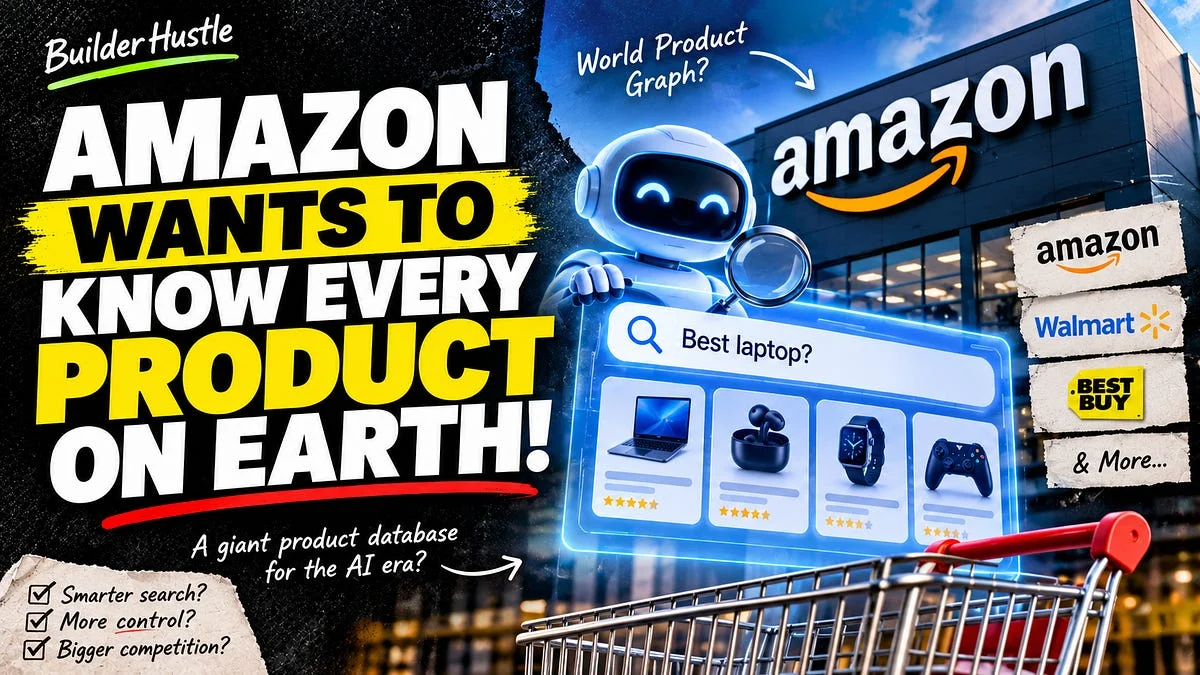
Amazon already has one of the world’s biggest online shopping catalogues. But a reported internal project suggests it wants something much bigger: information about products across the entire web, including items it doesn’t sell.
The timing is interesting. AI assistants are changing how people research and compare products, and retailers don’t want to lose control of that journey.
Let’s dive in.
Imagine searching for a new laptop.
You ask an AI assistant which models are worth considering. It compares prices, checks specifications, reads reviews, looks at alternatives and recommends the one that best fits your needs.
You never visit Amazon. You never see its sponsored product placements. You may not even know which retailer eventually gets the sale.
That is a problem for Amazon.
For years, the company has benefited from being somewhere people go not just to buy things, but to research them. Now AI shopping assistants could take that research experience somewhere else.
Amazon appears to be taking that threat seriously.
On November 13, Reuters reported that Amazon is considering an internal initiative called World Product Graph, a project designed to build an enormous database of products sold around the world, including items that Amazon does not actually stock.
The idea is ambitious: understand what is available across the entire retail market, so customers have fewer reasons to leave Amazon when researching what to buy.
It is also a revealing look at how the battle for online shopping could change.
Amazon wants more than a bigger catalogue
Amazon already has one of the world’s largest product catalogues. But having millions of product listings is not the same as understanding every product.
Think about buying a television.
You might want to compare screen technology, refresh rates, operating systems, dimensions, connectivity, pricing and whether a particular model is a meaningful upgrade over last year’s version.
A product listing can provide some of that information. The rest often requires visiting manufacturers’ websites, reading independent reviews and searching forums.
Amazon’s reported proposal aims to bring much more of that information together.
According to the internal document reviewed by Reuters, World Product Graph would combine information supplied directly by brands with product information gathered from other retailers’ websites.
The document reportedly names Coca-Cola and Bayer as companies that had agreed to contribute product data. It also describes a trial involving Procter & Gamble.
The database could help Amazon identify product relationships, distinguish newer models from older ones and recommend products based on what customers actually need, rather than simply matching a search term.
In other words, Amazon wants to become a place where people can discover and understand products, even when those products are sold elsewhere.
There is a business reason for that ambition. The more research customers do inside Amazon, the more opportunities the company has to influence what they consider, what they click and where they eventually spend money.
The bigger issue for retailers? AI shopping could change where customers start, and who influences the purchase. A shopper might still buy the same product, but an AI assistant comparing across retailers and showing only three recommendations could bypass sponsored listings, category pages, and promo placements. That matters because retail media is huge: Amazon and Walmart reportedly hold 88% of the estimated $74.4 billion U.S. retail media market.
The competition is no longer just Amazon vs. Walmart. It’s Amazon vs. the AI assistants trying to become the new front door to shopping.
Eye Bags and Wrinkles? Fix Them in One Step with Particle Face Cream.

If your face looks tired every morning—eye bags, wrinkles, rough skin—you're not alone. Particle Face Cream was engineered for men to tackle these issues in one simple step. This 6-in-1 solution reduces eye bags, diminishes wrinkles, brightens dark spots, hydrates, soothes after shaving, and nourishes deeply with Dead Sea minerals. No complicated routines. Just apply twice a day and see the difference. Builder Hustle readers can now take advantage of our early Black Friday offer: 25% off with the code NEWS25, along with a 30-day money-back guarantee.
back to our story…
Product information is becoming part of the competition
One of the less obvious consequences of AI shopping is that product information itself is becoming more valuable.
A product name and a photograph are no longer enough to support a genuinely useful recommendation.
An assistant comparing laptops needs accurate specifications. Someone buying a camera may care about lens compatibility. A person choosing a VR headset needs to know which games it supports and whether their PC hardware is suitable.
That last example shows why context matters.
A headset can look like a great deal, but it may not be the right purchase for someone’s existing setup. Resources such as VRHow help people research VR hardware, games and compatibility before making that decision.
The same principle applies to almost every category: a useful recommendation requires more than a price, a product title and a sales pitch.
It requires reliable details about how the product fits into someone’s actual life.
That creates an interesting challenge for brands and retailers. Their information needs to be accurate not only for shoppers browsing a website, but also for software systems comparing thousands of products on a shopper’s behalf.
And there is a difference between making product information available and controlling how it gets used. Reuters noted that it could not determine how Amazon would crawl other retailers’ websites or whether it would need permission in every case.
The next shopping destination might not look like a store
For a long time, online retail followed a familiar pattern.
You searched for a product, opened a retailer’s website, browsed listings, compared options and eventually checked out.
AI is beginning to separate those steps.
The research could happen inside ChatGPT, Meta Muse, Google’s AI experiences or Amazon’s own assistant. The purchase could happen somewhere else. The customer might spend very little time interacting with the retailer’s traditional website.
Amazon’s reported World Product Graph proposal suggests that the company sees this as more than a technology trend. It is potentially a threat to the position it has spent decades building.
But the outcome is not settled.
If AI assistants make shopping genuinely easier, consumers may prefer them regardless of which company controls the underlying product database. On the other hand, retailers with the most complete and trustworthy information could have a major advantage.
And if recommendations become difficult to verify, people may return to independent reviews, specialist publications and trusted comparison websites.
The interesting battle is not simply over who sells the product.
It is over who helps people decide what is worth buying in the first place.
Amazon built an enormous store. Now it may be trying to build the information layer that tells the world what to buy.
Stay sharp,