
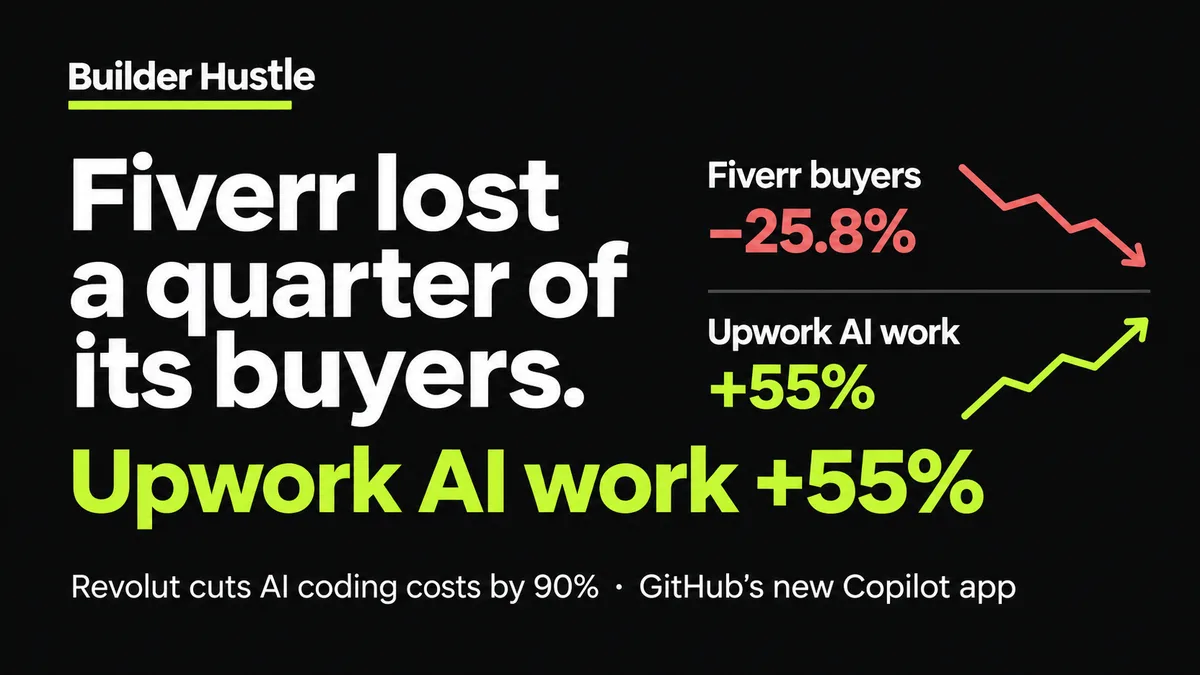
Fiverr lost a quarter of its buyers. Upwork’s AI work grew 55%.
Plus: Revolut cut AI coding costs by 90%, GitHub’s new Copilot app, and a better way to handle client feedback.
Fiverr and Upwork have both reported their third-quarter results, and the numbers tell an interesting story.
Fiverr has about 26% fewer active buyers than it did a year ago. Upwork’s gross services volume is down 10.1%, and its active client base is shrinking too.
But there’s one area moving in the opposite direction: AI-related freelance work.
Upwork says gross services volume from freelancers with AI skills grew 55% year over year, reaching an estimated annualized run rate of nearly $450 million.
That’s a significant shift in a market where traditional freelance activity is under pressure.
Also this week: Revolut shared how it cut AI coding inference costs by 90%, GitHub introduced a new Copilot app for managing agent-driven projects, and developers got another useful option for switching AI models without redeploying their apps.
Let’s get into it.
Fiverr lost 26% of its buyers. Upwork’s AI-skilled work grew 55%.
Two major freelance marketplaces, two very different sets of numbers. Both point to a changing market.
Fiverr: Fewer buyers, but higher spending
Fiverr reported Q3 revenue of $90.9 million, down 15.8% from $107.9 million a year earlier.
But the more revealing number is its marketplace activity.
Annual active buyers dropped from approximately 3.3 million to 2.4 million, a 25.8% decline.
Marketplace revenue also fell 24.7%, to $55.4 million.
Here’s the interesting part: annual spend per buyer actually increased 12.9%, from $330 to $373.
In other words, Fiverr is losing buyers, but the ones remaining are spending more.
Management pointed to persistent search traffic problems and the shift from traditional search toward AI-driven discovery. Fiverr now expects these marketplace traffic headwinds to become more significant through 2027.
That’s worth paying attention to. The problem isn’t necessarily that businesses have stopped buying services. It’s also becoming harder for traditional marketplaces to capture demand when the way people discover products and services is changing.
In partnership with Pincushion

Feedback your AI agent can actually read
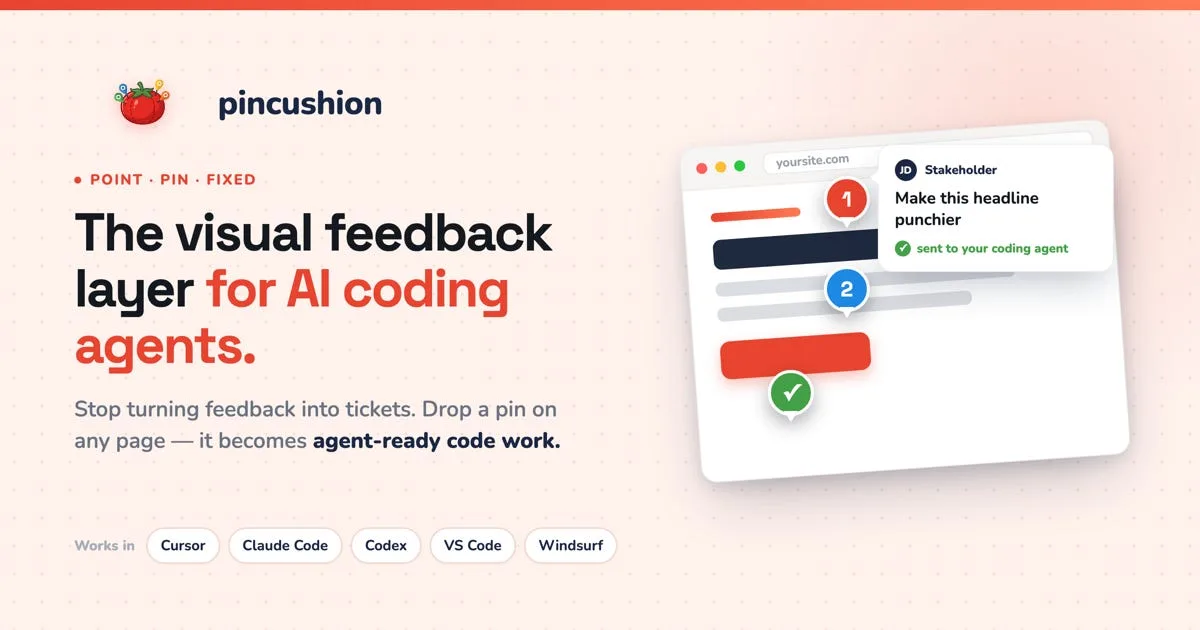
Still dealing with client feedback through screenshots, Slack messages and endless back-and-forth?
Pincushion lets clients, PMs and teammates drop pins right on your live app, free. Your AI coding agent (Claude Code or Cursor) reads every pin over MCP and ships the fix. One builder, unlimited free commenters, no more screenshot threads. See real public crits on Explore.
Now, back to what we were talking about.
Upwork: The wider marketplace is shrinking, but AI work is growing
Upwork’s Q3 results show a similar slowdown.
Gross services volume (GSV), which measures the value of work transacted through its marketplace and workforce services, fell 10.1% year over year to $914.1 million.
Active clients declined 10%, from 794,000 to 717,000.
Revenue came in at $185.6 million.
However, GSV per active client increased 8% to $5,418.
And then there’s the number that stands out:
GSV from freelancers with AI skills increased 55% year over year.
Upwork estimates that this category reached an annualized GSV run rate of nearly $450 million in Q3 2026.
That’s a substantial opportunity, especially when the wider marketplace is contracting.
Upwork is also preparing for AI agents to become customers.
In August, the company launched an MCP server that allows AI assistants and agents to interact with its marketplace.
Since launch, weekly active users have increased 20x. AI agents have made nearly 50 million requests through the server, generating more than $3 million in estimated annualized Connects revenue.
On November 2, Upwork introduced Upwork Now, a public beta that connects clients and AI agents with freelancers who are online and ready to start working.
Think about what that means.
A client might ask an AI assistant to find someone to build a website, design a logo or fix a technical issue. Instead of leaving the assistant to search manually, the workflow can connect directly with available talent.
AI agents aren’t just helping freelancers complete projects. They’re potentially becoming another way clients find and hire them.
What this means for independent builders
I wouldn’t interpret these numbers as the end of freelancing. I’d interpret them as a change in what clients are willing to pay for.
Generic services are becoming easier to automate. The value is shifting toward people who can understand a business problem, use the right tools and deliver a finished result.
A few practical changes worth making:
Sell outcomes, not just skills. Instead of advertising yourself as a website developer, show how you can build, launch and improve a complete website.
Make AI part of your workflow. Automations, AI-assisted development, integrations and agent workflows are increasingly useful skills.
Show proof. A working project, measurable result or detailed case study is more convincing than another list of software you know.
Build outside marketplaces. Your own website, portfolio, referrals and direct relationships matter when platforms themselves are facing traffic problems.
There’s another part of client work that often gets overlooked: feedback.
You can build a website with AI in a few hours, but then spend days translating client messages, screenshots and vague instructions into actual fixes.
That’s exactly what today’s sponsor, Pincushion, is built to solve.
Clients, designers and teammates can click directly on your live website and leave feedback on the exact element they want changed. No account is required for reviewers.
Your coding agent can then read those pins through MCP, complete the changes and resolve the feedback.
It works with tools like Claude Code, Cursor, VS Code and Windsurf.
For freelancers and small agencies, that means less time going back and forth over screenshots and more time shipping the actual work.
Try Pincushion on your next client project →
Revolut says it cut AI coding costs by 90%
This one is particularly interesting for developers and small software teams.
Revolut says it significantly reduced its AI coding inference costs after moving away from relying primarily on commercial AI APIs and adopting self-hosted open-weight models.
David Abitbol, who leads AI operations at Revolut, shared the details during a presentation on October 29.
Here’s what the setup looks like:
Approximately 2,000 engineers using the system.
56 NVIDIA B200 GPUs.
Self-hosted GLM models for coding workloads.
Around $0.30 per million tokens in reported serving costs.
According to Abitvol’s presentation, the new setup costs roughly one-tenth of what Revolut previously paid for comparable Anthropic and OpenAI usage.
That’s where the reported 90% reduction comes from.
But the more interesting part isn’t just the price.
Cheaper AI changes how developers use it.
When every API request has a meaningful cost, engineers naturally become selective about what they delegate to AI.
With much cheaper inference, they can use AI more freely for debugging, handling Jira tickets, searching Confluence documentation and working through routine engineering tasks.
The goal is no longer simply to generate code faster. It’s to reduce the time spent across the entire development process.
The catch
This isn’t something every startup should immediately copy.
Running 56 B200 GPUs requires substantial infrastructure investment. Revolut also had to optimise model serving, latency, hardware utilisation and its wider engineering setup.
The $0.30 figure is a reported inference cost, not a complete calculation of total ownership costs. Infrastructure, staffing, electricity and monitoring still matter.
For smaller teams, using a commercial API may remain the more economical option.
What you can do
You don’t need to buy GPUs or build your own AI infrastructure.
Start by testing a cheaper open-weight model through an API on a real task.
Compare its output quality, response time and cost against your existing model.
Not every task needs the most expensive model available. Sometimes the best optimisation is simply choosing the right model for the job.
Watch David Abitbol’s presentation.
Quick hits
GitHub launched its Copilot app.
At GitHub Universe on October 28, the company introduced a new Copilot app designed to coordinate AI agents across projects, repositories and connected tools.
You can describe a goal, provide context such as repositories, design mockups or Slack conversations, and let Copilot coordinate agents to work toward a result.
Copilot Projects are currently in public preview.
GitHub also made Copilot Fusion generally available. Instead of manually selecting a model for every task, Fusion can route and orchestrate different models depending on the work.
GitHub reports that Fusion Max achieved a score of 60 on the Artificial Analysis Coding Agent Index, within two points of Claude Code with Opus 5.5 Max, at roughly half the average API cost per task and 40% less time.
Mistral released Large 4’s open weights.
Mistral Large 4 is a multimodal model with 1.05 trillion total parameters and 52 billion active parameters.
It supports a 1-million-token context window and is designed for coding, agent workflows and multimodal tasks.
Its published API pricing is $0.70 per million input tokens and $2.10 per million output tokens.
The open weights give developers more flexibility, although independently running a model of this size still requires serious infrastructure.
Vercel introduced Virtual Models for AI Gateway.
Developers can now create reusable model IDs and change the underlying model, settings and fallback configuration centrally.
Your application keeps calling the same model ID, even when you switch the underlying provider or model.
The useful part? You can change the configuration without editing your application code or redeploying.
This could make experimenting with different models and managing AI costs much easier.
That’s the issue for this week.
Keep building, keep experimenting, and don’t get too attached to the tools. They’re changing faster than most of us can keep up with.
See you in the next issue.
Stay sharp,