
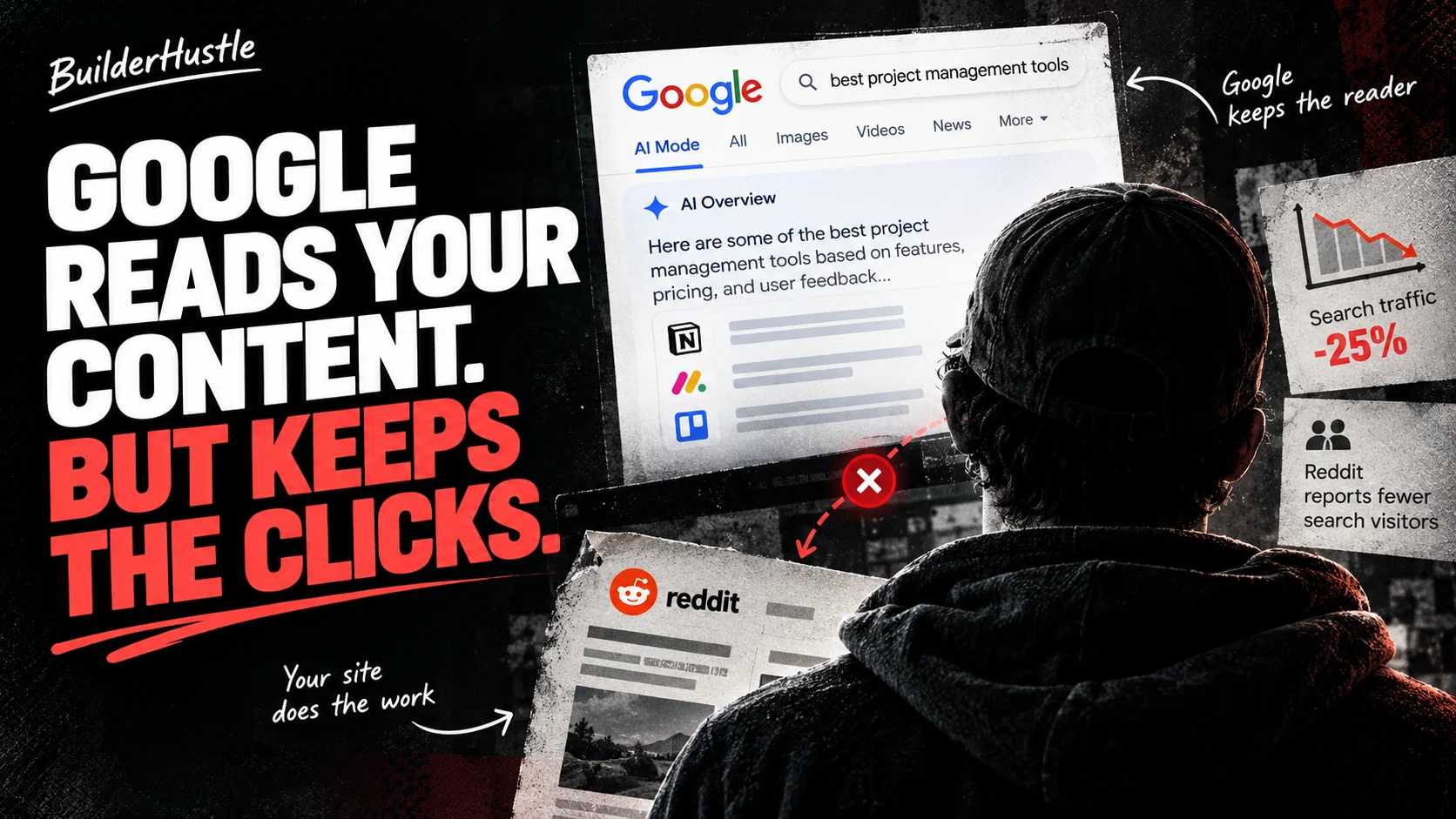
Google Is Still Reading the Web. It’s Just Sending Fewer People Back.
Reddit’s CEO just highlighted a problem that every website owner should pay attention to. AI search is changing the deal between the platforms that use our content and the people who create it.
For most of the internet’s life, there was a fairly simple arrangement.
You published something useful. Google found it, indexed it, showed it in search results, and hopefully sent visitors to your website.
You got traffic. Google got useful pages to show people. Everyone had a reason to participate.
It wasn’t a perfect deal, but millions of websites were built around it.
Now there’s a new problem. Google can still read your website, understand its content and use it to answer questions. But the person searching might never need to visit your website.
And Reddit’s CEO just gave us a pretty interesting example of what that looks like.
Google is crawling. The visitors aren’t following.
During Reddit’s latest earnings call, CEO Steve Huffman was asked about the company’s declining search traffic.
His response was worth paying attention to:
“Google is crawling us as hard as ever. The reality is the AI Mode does not drive traffic, not for us, and not to anybody as far as I know.”
That’s a big statement.
Reddit hasn’t suddenly become irrelevant. People are still searching for Reddit discussions, product recommendations, personal experiences and answers to everyday questions.
But the company says Google is sending fewer people its way.
According to Reddit’s shareholder letter, search referrals fell by more than one million per week on average during October. The company also warned that, if the trend continues, its total daily active unique visitors could decline by a low double-digit percentage in Q4.
To be clear, that’s a warning based on current trends, not a decline that has already happened.
And here’s the interesting part: Reddit isn’t exactly having a bad year.
Its third-quarter revenue increased 53% to $895 million. Global daily active unique visitors grew 12% to 130.3 million.
However, US daily active uniques were down 2% year over year.
So the business is growing, but its relationship with search is changing.
In partnership with

Multitasking makes for sloppy marketing
You don’t need to run paid media, SEO, email, and everything else by yourself. We have a full team ready to take it off your plate, so you can focus on the parts of your business only you can do.
Get a free growth plan and see what having backup actually feels like.
Google has its own interesting problem
The timing is particularly interesting because Google is also reporting strong AI-related growth.
Its latest quarterly results showed Google Cloud revenue more than doubling to $30.7 billion, beating analyst expectations. Alphabet’s overall revenue reached $127.6 billion, up 25% year over year.
Search isn’t disappearing either. Google Search and other revenue increased 12% to $63.35 billion.
Google also said its search query growth rate was the highest in five years.
Those numbers are important because they show a more complicated picture than “AI is killing Google.”
Google is growing. Its cloud business is booming, and people are still searching.
But there’s a difference between someone searching more and someone clicking through to another website.
Google can get more engagement inside its own products while publishers receive fewer visits from those same searches.
That’s the tension.
What happens when the source stops benefiting?
Think about the websites behind those answers.
Someone spends hours researching a topic, testing a product, writing a guide or sharing their experience. Google crawls that information and makes it useful to someone searching.
But what happens when that person gets the answer without visiting the original website?
For a large company, losing some referral traffic might be manageable. For a small publisher earning through advertising, affiliate links or subscriptions, those visits can make a real difference.
And this isn’t just about blogs.
Independent software companies depend on search to get discovered. Product review websites need visitors. Developers publish documentation. Communities share knowledge. Small businesses build pages to reach people looking for their services.
All of them have some relationship with search.
If that relationship becomes less valuable, website owners will eventually reconsider how much free content they make available, which platforms they allow to crawl it, and whether their information should be licensed instead.
That’s not necessarily where things are headed, but it’s a question the industry can no longer ignore.
The next move is about owning the relationship
Reddit’s response is interesting.
Instead of depending entirely on Google to bring people back, the company wants to turn Reddit into a destination people visit directly.
It’s focusing on its app, logged-in users, personalized feeds and making the platform a daily habit.
That makes sense. People who already know a product and choose to visit it are a different kind of audience from someone who happens to click a search result.
And I think smaller website owners should pay attention to this shift, too.
I’m not suggesting you abandon SEO. Search can still bring valuable visitors, and Google’s own numbers show that search activity remains significant.
But relying on one company to introduce people to your work is a risky position.
Give visitors a reason to return. Create useful tools, original research or communities that people can’t get from a quick AI summary. Make your product or website worth remembering.
A search result might introduce someone to your work. You need to give them a reason to come back.
The internet is still figuring out the new deal
I don’t think Google and the open web are suddenly going to stop working together.
Google needs useful information, and websites need ways to reach people. Both sides have something to lose if that relationship breaks down.
But the old arrangement is clearly under pressure.
Reddit is one of the biggest websites on the internet, and even it is questioning how much value it gets from being crawled when fewer visitors arrive.
For smaller publishers, the question is even more important.
Being found is good. Being visited is better. And being remembered might become the most valuable thing of all.
Stay sharp,