
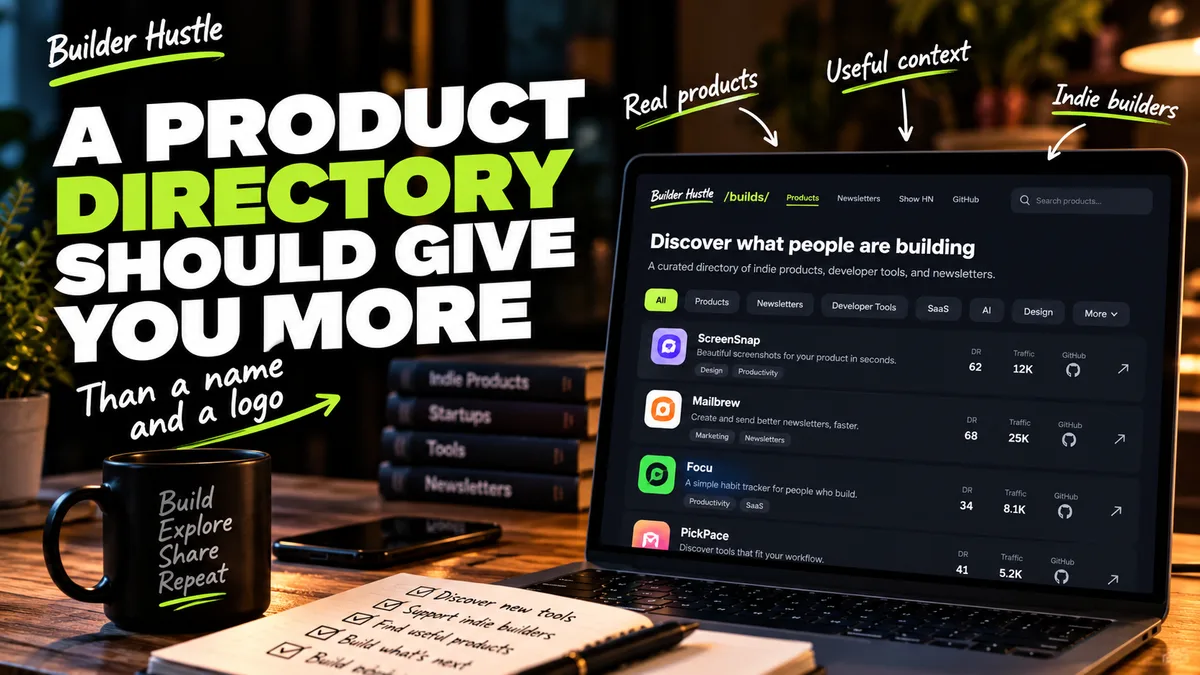
A Product Directory Should Give You More Than a Name and a Logo
Finding new software isn’t hard. The annoying part is figuring out which tools are actually worth your time.
If you spend five minutes browsing most startup directories, you see the exact same template. You get an icon, a name, a vague one-sentence pitch, and a button to visit the site. Maybe there is a “featured” tag or an upvote counter, too. Most of the time, the whole page just looks like a wall of logos begging for clicks.
Look, directories are fine for stumble-upon discovery. They help you find things you wouldn’t see otherwise. I just think they stop doing their job way too early.
Finding a Link Is Only Half the Problem
Say you want a better analytics tool, a newsletter platform, or just a neat little indie app to poke around in. You spot one in a directory and click through. Now the real work starts. You have to decode the landing page, hunt for the pricing tab, check their socials to see if the founder abandoned the project in 2024, and open three more tabs to compare alternatives.
Ten minutes later, you have eight tabs open and zero answers. The directory gave you a link, not clarity.
That is the gap I want to fix. A good listing should answer basic questions before you ever leave the page:
What does this actually do?
Who is it built for?
What problem does it solve?
Is the site fast, active, and alive?
You won’t get every answer for every tool, of course. Still, giving people real context upfront saves everyone a lot of wasted clicks.
Upvotes Don’t Tell the Whole Story
Launching is fun. Hitting the top of a leaderboard brings a great spike of traffic, early feedback, and your first handful of users.
The thing is, launch day lasts 24 hours. A product has to live for years.
Plenty of great tools totally flop on launch day because the maker doesn’t have an audience to rally for upvotes. Lots of small newsletters have sharp writing and tiny subscriber counts. A popularity contest won’t surface those projects.
I would much rather try a tool because it solves an annoying problem than skip it just because it didn’t trend on a Tuesday. Popularity is just one data point, and honestly, it is rarely the most helpful one.
Today’s Partner: Regus
What does an office actually cost? With Regus, one number.

A traditional office is never one bill. It’s rent, plus internet, plus cleaning, plus utilities, plus the receptionist, plus the fit-out you financed up front. Budgeting it is a job in itself.
With Regus, one simple monthly price covers everything: internet, cleaning, utilities, and admin support. No extra fees, no surprises. Private, professional offices for your team with everything included and no capital outlay — rated 4.5 on Trustpilot, with 8M+ people working across the network. Only pay for the space you need, on terms that match your plans.
Tell Regus about your team and they’ll show you spaces and pricing that fit — usually within one business day.
What I’m Building Instead
I’ve been putting together Builder Hustle Builds to test this out. It is a discovery directory for indie software, dev tools, and independent newsletters.
I didn’t want to make another link graveyard where people drop a logo and pray for traffic. Instead, each listing pulls together clear product breakdowns, target audience info, public domain metrics, and site performance data where available.
I also built in a live feed of public builder activity, pulling straight from Show HN launches and active GitHub repos. And of course, there’s still a lot of work left to do
A Few Numbers Don’t Tell the Whole Story
To be clear, raw numbers aren’t a final verdict. A high domain rating doesn’t mean the software is good, and a fast website won’t magically get you paying customers. If a brand-new project has zero metrics, that doesn’t make it bad.
These signals are just there to help you poke around and make up your own mind without opening ten different browser tabs.
The page is live: builderhustle.com/builds, though I’m still tweaking it every week.
Giving Smaller Projects a Fair Shot
You shouldn’t need ten thousand followers or a famous co-founder just to get people to look at your work.
If you are building something useful, you can submit your project or newsletter directly on the site. Standard submissions are completely free, and there are a couple of optional paid tiers if you want to skip the review queue or get extra promo.
I am under no illusion that a directory will magically solve distribution. Getting customers is still a grind, and a listing anywhere won’t guarantee sales. Still, we can do a lot better than a giant wall of logos.
Sometimes a tiny bit of extra context is the only thing that makes someone stop scrolling and actually try what you built.
For an indie maker, one curious visitor who actually gets what you’re doing is worth way more than another “Product of the Day” badge.
Stay Sharp,